Choosing the right Alloy Titanium Rod supplier can shape a project’s safety, cost, and delivery schedule. In 2026, global buyers face a crowded market with uneven technical documentation, changing demand, and complex shipment requirements. A polished website is not enough.
This guide examines suppliers through measurable evidence. We consider alloy grades, diameter tolerances, surface condition, heat-treatment records, inspection reports, and production capacity. Buyers should also check whether certificates match the actual heat number on each bundle. A 6-meter rod may look perfect outside, yet its paperwork can reveal inconsistent testing. Small details matter.
Dr. Matthew J. Donachie Jr., author of Titanium: A Technical Guide, stated, “Titanium alloys are used where high strength and low density are required.” That principle still guides serious purchasing decisions. The best supplier is not always the cheapest. It should understand aerospace, chemical processing, medical, marine, or energy applications and explain limitations honestly.
Trust requires more than claims. Ask for EN 10204 documentation, ultrasonic testing options, dimensional reports, and traceable quality records. Confirm packaging before shipment. Rods need protection from moisture, impact, and contamination during long-distance transport.
No supplier is perfect.
Lead times can change. Minimum order quantities may limit smaller buyers. Some companies communicate well but provide weak technical support. Others offer excellent metallurgy but slow responses. This comparison recognizes those imperfections and encourages practical verification before signing a purchase agreement. It aims to help global buyers identify reliable Alloy Titanium Rod partners in 2026.
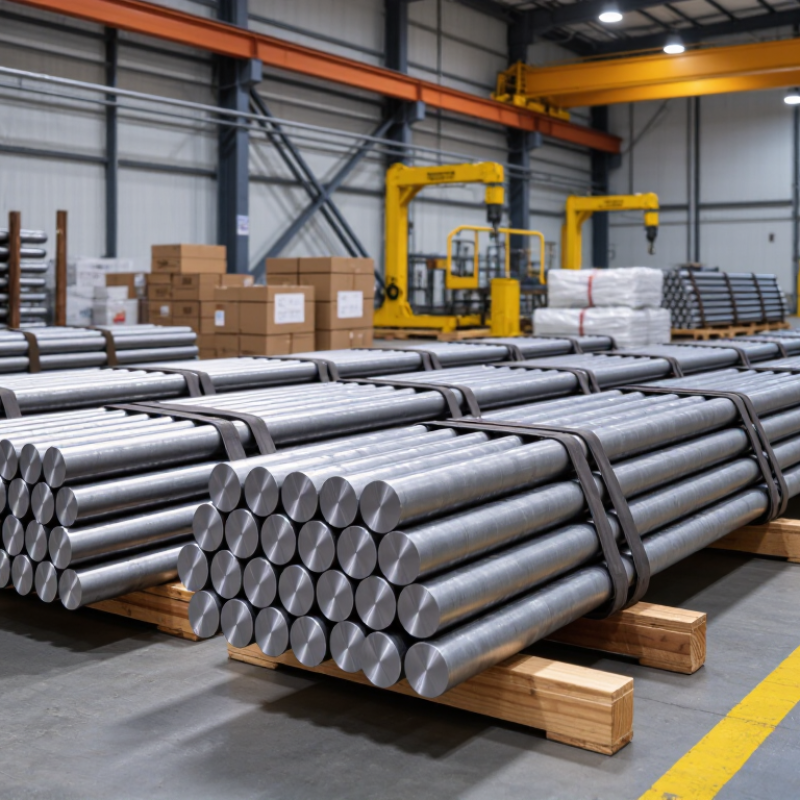
Titanium Rod Grades: Grade 2 (≥345 MPa) vs Grade 5 (≥895 MPa)
For 2026 global buyers, titanium rod selection should begin with verified mechanical data, not supplier claims. Grade 2 is commercially pure titanium, rather than a strict titanium alloy. ASTM B348/B348M specifies a minimum tensile strength of 345 MPa for Grade 2. It also offers strong corrosion resistance and better ductility. It is softer.
Grade 5, known as Ti-6Al-4V, reaches a minimum tensile strength of 895 MPa under the same ASTM specification. This strength suits aircraft structures, high-load fasteners, and demanding medical components. However, higher strength can reduce formability and complicate machining. A rod that looks perfect may still fail after poor heat treatment. Buyers should request mill test reports, heat numbers, chemical analysis, tensile results, and dimensional records.
The USGS Mineral Commodity Summaries 2025 identifies aerospace, chemical processing, and medical applications as important titanium markets. That demand increases the value of consistent traceability. For Grade 2, verify corrosion-service requirements and elongation results. For Grade 5, confirm the alpha-beta alloy condition, testing direction, and heat-treatment history. ISO 6892-1 provides a recognized method for metallic tensile testing. Ask suppliers to state the exact testing standard and sampling practice. Do not compare Grade 2 and Grade 5 by price alone. Procurement teams sometimes over-specify Grade 5, adding cost without practical benefit. A careful supplier explains that weakness clearly.
Grade 2 commercially pure titanium offers good corrosion resistance and moderate strength, while Grade 5 titanium alloy provides substantially higher tensile and yield strength for demanding structural applications. The minimum mechanical values shown are based on commonly specified ASTM B348/B348M rod and bar requirements at room temperature.
Standards Verification: ASTM B348, ASME SB348, ISO 9001, and EN 10204 3.1
2026 Best Alloy Titanium Rod Suppliers for Global Buyers?
For global buyers, standards verification should begin before price discussions. A credible supplier should provide traceable records for every titanium rod heat. ASTM B348 covers titanium and titanium alloy bars and billets, including chemistry, mechanical properties, dimensions, and permitted conditions. ASME SB348 is the pressure-equipment specification used when the purchase requires ASME compliance. Do not treat them as interchangeable automatically. Confirm the exact grade, size, condition, and edition stated in the purchase order.
Request the material test report before shipment. It should match the heat number marked on the rod bundle. Check titanium content, alloying elements, tensile results, yield strength, elongation, and heat treatment. Surface condition matters too. Scratches, laps, or excessive discoloration can create problems during machining. A document without traceability is weak evidence. Even a polished certificate may hide missing test details.
ISO 9001 verifies a quality management system, not the chemical composition of one rod. Ask for the certificate’s validity, scope, issuing body, and site address. EN 10204 3.1 certification should identify the manufacturer, product, heat, tests, and authorized inspection approval. It is not the same as independent third-party certification. Buyers should compare certificates with purchase specifications and inspection results. In practice, small gaps appear often. A missing signature, unclear unit, or mismatched heat number deserves clarification before acceptance.
Supplier Capacity Metrics: MOQ, Monthly Tonnage, Lead Time, and On-Time Rate
A reliable alloy titanium rod supplier should disclose four operating figures: MOQ, monthly tonnage, lead time, and on-time delivery rate. These numbers reveal capacity better than polished product pages. For common Ti-6Al-4V rods, a practical MOQ may range from 100 to 500 kilograms. Monthly capacity should be stated by grade and diameter, not as one impressive total. A supplier offering 300 tonnes monthly may still lack 20-millimeter aerospace-grade bar.
Lead time deserves careful testing. Stocked rods may ship within 7–14 days, while forged or specially tested material can require 6–12 weeks. The 2024 Deloitte Global Chief Procurement Officer Survey identified supply disruption and resilience as continuing procurement priorities. That supports demanding measurable delivery evidence. Ask for the last 12 months’ on-time rate, shipment count, and the definition of “on time.” A 98% rate from ten shipments is weak evidence. I would prefer 95% or higher across at least 50 orders, with late shipments explained by production stage.
Tips: Request a capacity sheet, not a sales promise. Check monthly output against furnace schedules, inspection queues, and export packaging time. Verify mill certificates, tensile results, ultrasonic inspection records, and traceability samples. ASTM B348 covers titanium and titanium alloy bars, but compliance alone does not guarantee punctual delivery. One overlooked detail is real. Holiday shutdowns and third-party testing can add two weeks. Build that risk into the purchase plan.
Global Compliance Checks: REACH, RoHS, Export Controls, and HS Code 8108.90
Global buyers should treat compliance as a purchase specification, not a paperwork exercise.
The USGS Mineral Commodity Summaries 2024 estimated global titanium sponge output at about 280,000 metric tons in 2023. This indicates a concentrated and traceability-sensitive supply chain. For alloy titanium rods, request heat numbers, chemical composition, mechanical results, country of melt, and independent test reports. Small gaps matter.
REACH checks should identify intentionally added substances and SVHC exposure. Under Article 33, suppliers must communicate SVHC information above 0.1% by weight in an article. REACH registration is different. It can concern substances manufactured or imported into the European Union. RoHS is narrower. It applies to covered electrical and electronic equipment, with ten restricted substances. Its limits include 0.1% for lead and 0.01% for cadmium in homogeneous materials. A titanium rod is not automatically a RoHS product. Request a declaration linked to the finished application.
HS code 8108.90 commonly covers titanium and articles thereof, other. National tariff schedules may add digits. Confirm classification with the importing customs authority. Export screening should consider EU Regulation 2021/821 and the U.S. EAR, when relevant. Check destination, end user, and end use. Do not rely on one supplier declaration. Audit practice shows that certificates can omit coatings, lubricants, or packaging materials. That weakness deserves review. Keep purchase orders, mill records, screening evidence, and test reports together. A shipment is defensible only when its lot history can be reconstructed.
2026 Supplier Scorecard: Price per Kilogram, Defect Rate, Traceability, and Incoterms
For a 2026 supplier scorecard, price per kilogram should be normalized before comparison. Include alloy grade, diameter, length, surface condition, testing, packaging, and freight. UN Comtrade 2024 records for HS 8108 provide trade values and quantities, helping buyers calculate broad unit-value benchmarks. These figures cover titanium products broadly, not certified alloy rods. That limitation matters.
A low quote can be a trap. Ask for the last twelve months’ defect rate, first-pass yield, and rejected-lot count. Define defects clearly: chemistry failure, dimensional drift, cracks, surface damage, or missing documents. ASTM B348 and ISO 2859-1 can support product and sampling controls. In my procurement reviews, missing heat numbers caused more delay than visible surface marks. Still, supplier-reported data needs independent checks.
Traceability should connect each rod to a melt, heat treatment, forging route, test result, and certificate. Request EN 10204 3.1 documentation, chemical analysis, tensile results, and non-destructive testing records. USGS Mineral Commodity Summaries 2025 places global titanium mineral concentrate output near 14 million metric tons in 2024, but upstream volume does not guarantee rod availability or quality. Record Incoterms beside every price. FCA may expose the buyer to export logistics, while DDP can hide compliance and tax assumptions. Require the named place, insurance responsibility, delivery window, and transfer-of-risk point. Some scorecards still overvalue price. That is worth questioning.
2026 Best Alloy Titanium Rod Suppliers for Global Buyers? - 2026 Supplier Scorecard: Price per Kilogram, Defect Rate, Traceability, and Incoterms
Anonymized 2026 procurement benchmark for alloy titanium rod suppliers
| Supplier ID |
Typical Alloy / Standard |
Price
USD/kg |
Minimum Order
Quantity |
Nonconformance
Rate |
Traceability
Score / 5 |
Mill Test
Certificate |
Typical Lead
Time |
Incoterms
Available |
Export
Readiness / 5 |
Composite
Score / 100 |
| Supplier A |
Ti-6Al-4V / ASTM B348 Grade 5 |
28–36 |
100 kg |
1.8% |
4.6 |
Heat and lot level |
4–6 weeks |
FCA, FOB, CIF, DAP |
4.7 |
91 |
| Supplier B |
Ti-6Al-4V / ASTM B348 Grade 5 |
24–31 |
250 kg |
2.6% |
4.1 |
Heat level |
5–8 weeks |
EXW, FOB, CIF |
4.2 |
86 |
| Supplier C |
Ti-6Al-4V ELI / ASTM B348 Grade 23 |
42–58 |
50 kg |
1.2% |
4.9 |
Heat, lot and test report |
6–9 weeks |
FCA, CIP, DAP |
4.8 |
94 |
| Supplier D |
Ti-6Al-4V / ASTM B348 Grade 5 |
31–40 |
75 kg |
2.1% |
4.4 |
Heat and lot level |
4–7 weeks |
FOB, CFR, CIF |
4.4 |
89 |
| Supplier E |
Ti-5Al-2.5Sn / ASTM B348 Grade 6 |
35–47 |
150 kg |
3.0% |
3.8 |
Heat level |
7–10 weeks |
EXW, FCA, FOB |
3.9 |
82 |
| Supplier F |
Ti-6Al-4V / ASTM B348 Grade 5 |
22–29 |
500 kg |
3.8% |
3.5 |
Batch level |
6–10 weeks |
EXW, FOB, CFR |
3.6 |
78 |
Benchmark notes: Prices are indicative USD/kg ranges for standard alloy titanium rods and vary by diameter, length, surface condition, order volume, testing requirements, freight, and market conditions. Nonconformance rate represents the percentage of inspected lots requiring corrective action. Composite scores use indicative weighting: price 20%, quality 25%, traceability 20%, delivery 15%, export readiness 10%, and MOQ flexibility 10%. Confirm current quotations, inspection records, material certificates, export documentation, and applicable Incoterms before purchase.
FAQS
Grade 2 offers better ductility and corrosion resistance. Its minimum tensile strength is 345 MPa. Grade 5 reaches 895 MPa. It is stronger but less formable.
Grade 5 usually suits aircraft structures, demanding medical components, and high-load fasteners. Strength matters here. However, Grade 5 can require more difficult machining and careful heat treatment.
Choose Grade 2 when corrosion service and easier forming matter more than maximum strength. It is softer. Confirm elongation results and the actual service environment before purchasing.
Request the mill test report, heat number, chemical analysis, tensile results, and dimensional records. The heat number should match the bundle marking. Paperwork alone is not enough.
Ask for the tensile testing standard, sampling method, test direction, and heat-treatment history. Testing should use a recognized metallic tensile procedure. A perfect-looking rod may still fail.
No. It shows a management system, not the chemistry of one specific rod. Check certificate validity, scope, issuing body, and production site. That distinction is easy to miss.
It should identify the manufacturer, product, heat, test results, and authorized inspection approval. Check signatures, units, and matching heat numbers. Small gaps deserve questions.
Treat compliance as part of the purchase specification. Request composition, country of melt, heat records, and relevant substance declarations. Review coatings, lubricants, and packaging too. They can be overlooked.
Conclusion
Choosing the best Alloy Titanium Rod supplier in 2026 requires more than comparing basic prices. Buyers should first match material grades to application needs: Grade 2 offers strong corrosion resistance with a minimum tensile strength of 345 MPa, while Grade 5 provides higher performance at a minimum of 895 MPa. Reliable suppliers should verify compliance with ASTM B348, ASME SB348, ISO 9001, and EN 10204 3.1 documentation, supported by complete heat and batch traceability.
A practical supplier scorecard should assess MOQ, monthly production capacity, lead time, and on-time delivery performance. Global buyers should also review REACH and RoHS status, export-control procedures, and the accuracy of HS Code 8108.90 classification. Final selection should balance price per kilogram with defect rate, inspection quality, traceability, packaging, and suitable Incoterms. This structured approach helps buyers reduce supply risks and secure consistent, compliant titanium rod deliveries.

 ProX Metal