For global buyers, choosing a China-based ASTM B348 Titanium Bar supplier requires more than comparing prices. It requires verified material quality, stable production, and clear communication. ASTM B348 covers titanium and titanium alloy bars and billets for demanding industrial applications. Buyers should confirm the supplied grade, diameter, surface condition, and applicable test requirements before placing an order.
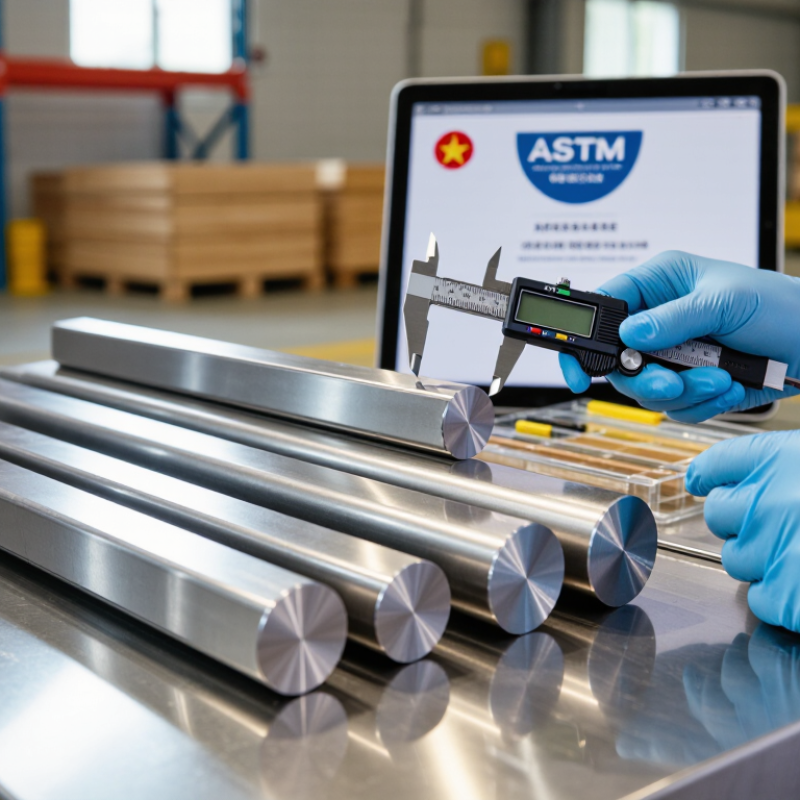
An experienced supplier should provide heat numbers, mill test certificates, chemical composition, mechanical results, and dimensional inspection records. These documents connect each bar to its production history. A professional quality team may check diameter with calibrated instruments and inspect surfaces for cracks, dents, or excessive oxidation. Packaging also matters. Strong wooden cases, protective separators, and moisture control can reduce damage during long-distance transport.
Reliability grows through evidence.
Global purchasers often need support with grade selection, sampling, third-party inspection, and export documentation. A capable China supplier should explain limitations instead of promising everything. Some projects need additional ultrasonic testing, tighter tolerances, or special straightness requirements. These details must be confirmed in writing. One certificate is not enough.
There is room for improvement.
This guide explores how buyers can assess an ASTM B348 Titanium Bar manufacturer through technical capability, traceability, inspection discipline, and delivery performance. It also considers practical warning signs, such as unclear certificates, inconsistent dimensions, or vague answers about alloy composition. Real purchasing decisions involve uncertainty. Careful verification helps reduce it. With transparent records and responsive engineering support, global buyers can build a more dependable supply relationship with a qualified Chinese titanium bar supplier.
ASTM B348 Titanium Bar: Definition, Scope, and Applications
ASTM B348 defines requirements for wrought titanium and titanium alloy bars and billets. It covers chemical composition, mechanical performance, dimensions, and required testing. Common grades include commercially pure titanium and alloyed grades such as Grade 5. The standard supports consistent purchasing between mills, fabricators, and global buyers. However, ASTM B348 does not automatically approve a bar for every service condition. Grade selection still requires engineering review.
Titanium bars are used in heat exchangers, chemical processing equipment, marine fittings, aerospace structures, and selected medical components. Their low density and strong corrosion resistance are valuable near seawater, chlorides, and process chemicals. The USGS Mineral Commodity Summaries 2024 reported global titanium mineral concentrate production above 9 million metric tons in 2023. This large upstream supply does not guarantee identical bar quality. Processing route, heat treatment, grain structure, and surface condition still matter. They matter greatly.
For practical procurement, buyers should request the ASTM edition, grade, diameter tolerance, test certificate, and traceability records. A bar may look bright and uniform while hiding unsuitable chemistry or inconsistent mechanical results. That distinction is easy to miss. Independent verification can reduce risk, especially when bars enter welded assemblies or rotating parts. Suppliers should also confirm whether the application needs annealed material, special straightness, or additional nondestructive testing. Overlooking one detail can weaken an otherwise careful specification.
| Data Category | Specification or Grade | Technical Information | Typical Applications |
|---|---|---|---|
| Standard Definition | ASTM B348 | Standard specification covering titanium and titanium alloy bars and billets intended for general industrial use. | Machined components, fabricated assemblies, chemical-processing equipment, aerospace and medical parts. |
| Product Forms | Bars and billets | Round, square, rectangular and other permitted bar profiles may be produced by forging, rolling, swaging or machining, subject to the purchase specification. | Forged parts, shafts, fasteners, rings, valve components and machined products. |
| Commercially Pure Titanium | Grade 1 / UNS R50250 | Lowest-strength commercially pure grade; excellent ductility, formability and corrosion resistance. Minimum tensile strength is commonly specified at approximately 240 MPa. | Heat exchangers, chlor-alkali equipment, chemical tanks, piping and formed components. |
| Commercially Pure Titanium | Grade 2 / UNS R50400 | General-purpose commercially pure titanium with a balance of strength, weldability and corrosion resistance. Minimum tensile strength is commonly specified at approximately 345 MPa. | Desalination equipment, marine systems, chemical-processing vessels, heat exchangers and piping. |
| Commercially Pure Titanium | Grade 3 / UNS R50550 | Higher-strength commercially pure titanium than Grades 1 and 2, while retaining good corrosion resistance and weldability. Minimum tensile strength is commonly specified at approximately 450 MPa. | Pressure-containing equipment, chemical-processing components and moderately loaded structural parts. |
| Commercially Pure Titanium | Grade 4 / UNS R50700 | Highest-strength commercially pure titanium grade in the commonly used Grade 1–4 group. Minimum tensile strength is commonly specified at approximately 550 MPa. | High-strength chemical equipment, marine hardware, aerospace components and structural fittings. |
| Alpha-Beta Titanium Alloy | Grade 5 / UNS R56400 | Titanium alloy containing approximately 6% aluminum and 4% vanadium; high specific strength and good fatigue performance. Annealed bar commonly has a minimum tensile strength near 895 MPa. | Aircraft structures, turbine components, pressure vessels, sporting equipment and medical implants. |
| Palladium-Modified Titanium | Grade 7 / UNS R52400 | Commercially pure titanium with a small palladium addition for improved resistance to reducing acids and crevice corrosion. Mechanical requirements are broadly comparable to Grade 2. | Severe chemical-processing environments, acid service, heat exchangers and pharmaceutical equipment. |
| Near-Alpha Titanium Alloy | Grade 9 / UNS R56320 | Titanium alloy containing approximately 3% aluminum and 2.5% vanadium; stronger than commercially pure grades with good formability and weldability. | Hydraulic tubing, aircraft systems, marine piping, sporting goods and lightweight structural components. |
| Molybdenum-Nickel Titanium Alloy | Grade 12 / UNS R53400 | Titanium alloy containing approximately 0.3% molybdenum and 0.8% nickel; offers improved crevice-corrosion resistance and higher strength than unalloyed titanium. | Chemical-processing equipment, heat exchangers, marine systems and brine-handling applications. |
| Corrosion Resistance | Titanium and titanium alloys | A stable, protective oxide film provides strong resistance to seawater, chlorides, many oxidizing acids and wet chlorine environments. Performance depends on concentration, temperature and flow conditions. | Desalination, offshore equipment, marine engineering and chemical processing. |
| Quality and Inspection | ASTM B348 compliance | Typical verification includes chemical composition, tensile properties, dimensional examination and surface inspection; additional testing may be specified by the purchase order. | Traceable industrial, aerospace, medical and pressure-service supply chains. |
| Important Purchasing Note | Grade, size and condition | Mechanical requirements can vary with grade, bar size, product condition and supplementary requirements. The latest applicable ASTM edition and the purchase order should control acceptance. | International procurement, qualification programs and application-specific material selection. |
Common grades include 1, 2, 3, 4, 5, 9, 12, and 23. Grades 1 through 4 increase in strength. Grade 5 suits high-load structural parts. Availability depends on production capability and order details.
Bars are commonly supplied as round, square, or hexagonal sections. Round bars range from machining sizes to large forged diameters. Square and hexagonal bars use width across flats. Standard and cut lengths are usually possible.
Grade 2 fits corrosion-resistant equipment and heat exchangers. Grade 5 provides higher strength for structural components. Grade 23 may suit applications needing better fracture toughness. The working environment still needs careful review.
Confirm diameter, width, length, straightness, surface condition, and tolerances. Provide clear drawings with marked inspection points. Do not confuse nominal diameter with measured tolerance. That mistake can delay production.
Certified sponge or approved alloy returns are melted under controlled conditions. Vacuum melting helps limit oxygen, nitrogen, and hydrogen contamination. Billets are then forged, rolled, or processed by both methods. Heat treatment adjusts strength and ductility.
Inspection should check chemistry, tensile properties, hardness, dimensions, and surface condition. Bars should not contain harmful laps, cracks, or deep seams. Ultrasonic testing may support critical applications. A polished surface proves very little.
Documents should identify the grade, heat number, test results, and specification. They should include chemical analysis and mechanical test results. Dimensional inspection records are also important. Traceability should continue from melting to packing.
Ask for calibration records, inspection photographs, and nonconformance procedures. Independent inspectors may witness sampling and review packing details. Check that bundle markings match the material certificate. Certification alone is not enough.
Protect bars from moisture, impact, and mixed-grade storage. Long bars need extra support during handling and shipment. Keep heat numbers visible on bundles. Packaging deserves more attention than it often receives.
ASTM B348 Titanium Bar is a standardized product used in demanding industries such as aerospace, chemical processing, medical equipment, marine engineering, and power generation. This specification covers titanium and titanium alloy bars, including commonly used grades with different combinations of strength, corrosion resistance, ductility, and temperature performance. Buyers can select suitable bar sizes, shapes, and surface conditions according to their design, machining, and service requirements.
Reliable production involves controlled melting, forging, rolling, heat treatment, machining, and surface finishing. Quality requirements typically include chemical composition control, dimensional accuracy, mechanical performance, and visual condition. For global purchasing, inspection reports, material certificates, traceability records, and applicable compliance documentation are essential. When evaluating an ASTM B348 Titanium Bar supplier, buyers should consider manufacturing capability, quality management, testing capacity, delivery reliability, technical support, and experience with international documentation. A dependable supplier should provide consistent products, clear communication, and complete verification records from raw material through final shipment.

 ProX Metal